
Losing a tooth is stressful. Whether it’s from a sports injury, a failed root canal, or deep decay, that gap in your smile can make you feel self-conscious and make chewing a chore.
If you’ve visited a dental provider recently to discuss tooth replacement, you’ve almost certainly heard about the dental implant. In fact, between 2006 and 2016, the number of implants placed in the U.S. multiplied fourfold. Dental implants are a popular solution because they have become the gold standard for replacing missing teeth.
But are they right for you? We want to walk you through exactly what implants work, how the implant procedure flows, and the honest pros and cons you need to know before getting dental implants.
What Exactly Is a Dental Implant?
First, let’s clear up a common misconception. When we say “implant,” we aren’t just talking about the white artificial teeth you see in the mirror.
A dental implant is actually an artificial root—usually a titanium implant—that is embedded directly into your jawbone. This implant body acts as a base for the implant restoration. Once that tooth root substitute fuses with your bone, we attach a dental prosthesis, such as a crown, on top of it.
The Three Main Parts
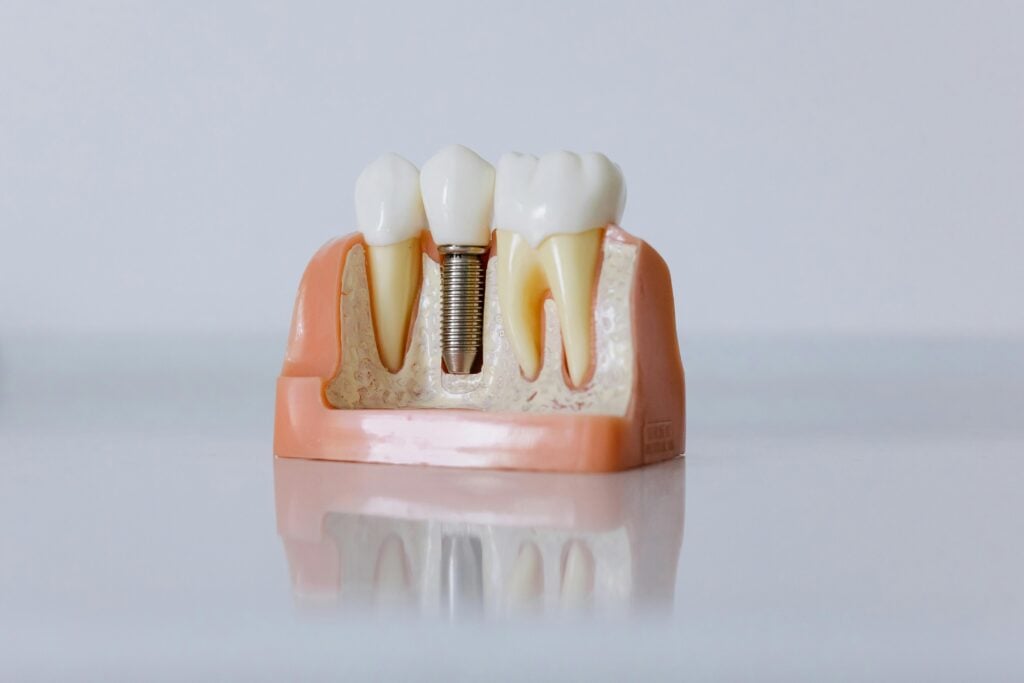
To understand the dental implant system, it helps to visualize the three components:
- The Implant: The screw-like post inserted into the bone (specifically an endosseous implant, meaning “within the bone”).
- The Abutment: The implant abutment is the connector piece that screws into the implant and holds the crown.
- The Restoration: The dental implant restorations (crown, bridge, or denture) that look and function like a single tooth or multiple teeth.
Why Choose an Implant Over a Bridge?
For decades, the standard way to fix a missing tooth was a dental bridge. A bridge involves shaving down the healthy tooth structure on either side of the gap to anchor a false tooth in the middle.
While a bridge or denture is still useful, dental implants offer distinct advantages:
- Implants Preserve Neighboring Teeth: Dental implants are used so we do not have to drill down the healthy adjacent natural teeth.
- Bone Health: Implants offer preservation of the jawbone because they fuse to the bone, whereas other methods do not.
- Natural Feel: Once healed, an implant can be placed that generally feels and acts just like a natural tooth with a dental restoration.
- Hygiene: You can use dental floss normally around the implant and your natural teeth, whereas bridges require difficult threading to clean underneath.
The “Checklist”: Are You a Candidate for Dental Implants?
While I love successful implants for many patients, they aren’t for everyone. Before we proceed with dental implant therapy, we have to tick a few boxes to ensure safety.
- You Must Have Adequate Bone: The implant is placed where it can be surrounded by strong, healthy bone. If you lack bone volume, we may need to perform grafting prior to implant placement.
- You Must Be Fully Grown: We generally avoid placing implants in children or teenagers. If a patient is not physically mature, the jaw continues to grow, but the implant (which is fused to the bone) will not move, leading to problems later.
- Overall Health Matters: Conditions like uncontrolled diabetes or heavy smoking can significantly lower the success of the implant.
- Space Requirements: There must be enough width and length between your roots and crowns to fit the implant and abutment.
The Process: It’s a Marathon, Not a Sprint
If you are looking for a quick fix, an implant surgery might frustrate you. The dental implant procedure from extraction to final crown can take nine months or longer. Here is the typical timeline:
1. Planning and Extraction
We start with X-rays or 3D scans to map your nerves and even the maxillary sinuses (if we are looking at implants and sinus proximity in the upper jaw). If the bad tooth is still present, we perform an extraction prior to implant work.
2. Placement and Osseointegration
The dentist or surgeon performs the placement of a dental implant into the bone. Then, we wait. This is the critical phase called osseointegration, where the surface of the dental implant physically bonds to your bone.
- Lower Jaw: Typically takes 3–4 months.
- Upper Jaw: Typically takes 4–6 months because the bone is more porous.
3. The Restoration
Once the surgeon confirms the implant system has fused, your general dentist creates the crown. We take detailed impressions to custom-make a tooth that blends seamlessly with your smile.
Note on Types: While a standard implant is most common, mini dental implants (or mini implants) are sometimes used in orthodontics as temporary anchorage. Short implants (or narrower ones) might be chosen if bone space is limited.
Titanium vs. Zirconia: What’s the Difference?
Titanium implants have been the material of choice since 1978 because they are biocompatible and bond incredibly well to bone.
However, some patients prefer a metal-free type of implant. Zirconia implants (a white ceramic material) are a type of dental implant approved by the FDA in 2011. While zirconia is aesthetic, it is more brittle than titanium and carries a higher risk of fracture. For most patients, implants made of titanium remain the proven choice.
Success Rates and Risks
The good news? Dental implants are generally very successful, with rates typically between 90% and 95%.
However, implant failure can happen:
- Peri-implantitis: This inflammation of the gum and bone around the implant is often caused by poor hygiene or excess cement. Regular dental visits are crucial to monitor this.
- Mechanical Failure: An implant may loosen, or porcelain crowns can chip—especially if you grind your teeth.
- The “Shock Absorber” Issue: Natural teeth have a ligament that gives them a little “bounce”. Dental implants also are rigid and do not have this. Your dentist must adjust your bite perfectly to prevent putting too much force on the implant body and dental crown.
The Bottom Line
Dental implants require a significant financial investment—often costing upward of $4,000 per tooth—but for many, the benefits of dental implants are worth it to regain the quality of life, chewing ability, and confidence of a natural smile.
If you are considering dental implant surgery, don’t just look for the cheapest price advertised online. Ask your dentist about their experience level (did they learn in dental school or a weekend course?), the number of implants they have placed, and the specific plan for your anatomy. It’s your mouth, and you deserve a result that implants last a lifetime. /Next Step: Are you unsure if you are a candidate for a single tooth implant, multiple tooth dental replacement, or full mouth dental implants? The process often requires coordination between surgical and restorative experts. At AIDM, we eliminate the hassle of referrals by housing all dental specialties under one roof. Schedule a comprehensive exam with our team today to ensure every stage of your dental implant treatment is handled seamlessly in one convenient location.